Harrison Butker and “That” Speech

OK, I wasn’t planning on posting this, but this site is about perspective. And maybe this offers a different perspective of the speech Harrison Butker gave.

Most everyone has an opinion about the speech he gave to a Catholic college graduating class. Anyone just going off the sound bites of this speech should read the entirety. He covers way more than women’s roles.

He suggests the graduates choose their residence based on whether the church offers a Traditional Latin Mass, admonishes Catholics for using birth control, says bishops no longer care about sacraments, and quotes Taylor Swift (oh the irony). So many controversial opinions, but that’s not my point here.

The point here is that he didn’t recognize that his audience was bigger than Catholic graduates. It appears he didn’t know or care that even though he was speaking in his own “personal capacity” as a Christian Catholic, he was also representing something much larger. He was asked to speak because he was a member of the Super Bowl winning Kansas City Chiefs. It would be arrogant for him to think he was asked to speak because he was some good Catholic.

If he took time to understand he was representing something bigger than himself, he would have thought about his words and crafted something that truly honored women and motherhood. But he also would have considered how it affected his team and his employer. In the age of social media and access to every move, public figures always have more than one audience.

Because he didn’t recognize that, he caused conflict and division for fans, players, coaches, and people without any interest in the sport at all. 

It irritates me to hear people say we shouldn’t judge because he was speaking in his “personal capacity.” It’s not about his right to speak his mind; it’s about who and what he is representing. There’s a tradeoff for making all that money by kicking a ball, Harrison. Your tradeoff is losing the privilege of “personal capacity.” You are now accountable for what you say and do based on your “public capacity.”

It’s a good reminder for all of us. We are always representing something bigger than ourselves when we speak. If we say things out of anger or judgment, can we excuse ourselves by saying, “Well that was just in my personal capacity?”

But what about how it impacts our partners, children, grandchildren, friends, coworkers, companies we work for? What we say and do impacts so many others. Most of us are not in the public spotlight, but we’re in someone’s spotlight. 

It was never just his personal capacity. I need to remember it’s not just mine either.

Friendships for Life. Or Not.

Life is hard. And complicated. Relationships so often help us navigate all that. But sometimes they are the source of that. I have had this conversation numerous times over the past months.

We all know people that were an important part of our lives.  And then small, very incremental, changes began happening. And we find ourselves no longer sharing the same experiences, feelings, or lifestyles. Very often, we become sad or confused, left wondering what went wrong with that relationship.

But the reality is that nothing really went “wrong.” Change will often break things down and put them back together again. Just not always in the same way. It’s challenging when friendships fall prey to this rearranging.

If we don’t realize that this happens to all of us, we can become resentful of the other person or left feeling guilty that we are somehow at fault for the changes. 

We’ve heard the adage, “Friends come into your life for a reason, a season, or a lifetime.” The problem arises when we think someone is a lifetime friend when things begin changing. That’s a tough one.

When life changes, and we no longer see certain friends every day like we used to, it’s natural for our lives to drift apart a little. That’s normal. Often, we will still find ways to get together, catch up, and enjoy each other. 

But then there are people who want more from us than we can give at this time. Or they relate with us from the perspective of who we once were. We often wish we could go back and pick up where we left off. But we usually can’t. The changes that have taken place dictate that’s not possible. 

It’s important to realize that it’s normal for relationships to shift. As hard as it is, we have to learn to release our expectations of what will be, without disparaging our memories of what once was.

Releasing someone we once thought would be in our lives forever, and not resenting them or feeling guilty because that has changed, is a sign of growth. We grieve the loss, express gratitude for what once was, and trust the future holds promise for the both of us. Not easy but sometimes it’s the only way to keep moving forward.

To Be Still

Noise is everywhere. It’s in front of us on our phones, it’s in the background on TV, it’s the constant broadcasting of news, it’s in our heads. Much of the time, it is by choice. Some of the time, we aren’t even aware. Silence is elusive, even when we’re alone.

There is a psalm that begins with, Be still and know. Can we hear our souls begging us to be still? We wonder why our nervous systems are always amped up. We read the warnings about our obsession with social media. But it’s hard to heed the warnings. Because silence scares us.

When dawn is about to break, there is an overwhelming silence around us. The light begins to appear and then the sunrise, and then the quiet beauty of that moment. Can we show up and simply take it in? Often we want to “document” the beauty and so we grab our cameras hoping we can catch a true impression.

When I was staying in Palm Springs, I was able to see the sunrise every morning. On mornings where it was very dramatic, I would walk outside to get a picture. It’s normal to want to take pictures. We want to revisit the moments; we want to share the impression with others.

But what about the impression it longs to leave on our soul?  Dawn comes and goes quickly, and the pictures never quite bring us back to that moment. But the sunrise stamps us every single time.

If beauty is everywhere, I want to show up and leave myself vulnerable to its impression. Noise blocks all that. It’s the beautiful versus the ugly, the stirring versus the settling, the peace versus the agitation.

Every time we witness beauty, every time we wish we had our camera, every time we can’t find words to describe what we saw or felt…let’s consider that maybe it was more about our souls being stamped than it was about being able to show and tell.

Showing up for beauty may start with just one minute of stillness. But it’s a good place to start. Taking a moment to be still and acknowledge the beautiful parts of our day is what’s most helpful in quieting noise, especially the noise in our heads.

Picking Up Our Power

We often don’t believe we have any power because the idea has been hijacked by people who use their positions to force their ways. People in every sphere use words to threaten and manipulate, and we have all been affected by it. As a result, most have come to see power as evil.

But real power involves invitation. Helping someone go from despair back to hope is more powerful than any act of force or coercion. We invite people to see a new perspective, to share our hope, to see bigger.

We’ve all had times when we get blindsided by something. We have a measure of hope and things are going relatively smoothly. And then. We get hit with a challenge we didn’t see coming. We are tempted to quit all the declarations we made about staying positive. We’ve all been there.

And it’s ok. Our minds can’t process life in an instant. It takes a minute to look at the challenge squarely in the face, and let the effects of the situation sink in.

I had an example of this recently. I was praying blessings over those I love, and I was seeing the effects of it. And then one of my kids was met with some misfortune. They were rightfully upset and sad over what had happened. As moms, we feel all the pain our kids feel. I texted a friend and said, “What good does blessing do? Nothing matters.”

Knee jerk response. Of course it matters. After a little time, I came back to that. I think it’s ok to go down with people who go down. It might take a minute, but if we are going to offer them a hand back up, we’re going to have to pull ourselves back up first. 

That “hand” we offer is often words. The next day, “Thinking about you. How are you doing today?” Checking in, standing with them, processing challenges alongside them. It’s not some big lecture or advice. We let them know they are not alone, and that helps them process and heal.

Despair is always trying to crash into mental spaces, our own and those we care about. By finding a thought or two that leans away from it, we are picking our power back up. The smallest of choices helps us bring light not only into our own lives, but also into the lives of those who may feel broken. 

We fill our hands up with words of invitation. We have the power to go from “Nothing matters at all” to “It all matters.” And how we see that matters a lot.

On Taylor Swift, Writing, and Also Therapy

Taylor Swift used these words to describe why she wrote the songs on her latest album, The Tortured Poets Department. Mostly about relationships gone bad, her pain was real and her life was undone. She said she HAD to write it. 

The imagery she uses throughout her songs is haunting. “My spine split from carrying us up the hill.” After writing heart wrenching songs to describe what she went through, she declared her tears holy as she released it. And then, by her own testimony, she was free of it.

We all have that same power. As we get older, our breakup stories have become distant memories, but we all have a measure of current pain. Time after time, I turned to words on paper when struggling. Those words, that so often helped me get through, didn’t exist before I dug in and pulled them out. 

A couple years ago, I went to therapy to get past some things that were hard. I wasn’t so much looking for advice as I was needing to flesh out what I was wrestling with. Speaking the words helped. If we don’t find words to express our pain, I think it just stays inside. We might be able to ignore it and push it deep, but it doesn’t get released. Sometimes therapy can help us get that done.

Here’s the thing. Sometimes we need words for our “sad stories.” We could be facing a serious problem or just finding ourselves with something we can’t get past. Poetry, stories, talks with friends, journal scribblings, therapy, and prayer…they all help us put words to what we are going through. They all provide opportunity to get “ink on the page,” and give shape to what we’re experiencing. It helps our tears become holy.

And fortunately for us, we don’t have to release our words to millions of people as part of our healing. We can sit all alone in front of a piece of paper, no one ever seeing or hearing it. Public or private, sometimes we just “HAVE to write it.”

Grateful to the poets who put words to what they go through, so we can learn from principles that apply to all of us. Thank you Taylor for sharing your pain…your poetry is brilliant. 

On Vulnerability

On the surface, vulnerability seems paradoxical. As we get brave enough to share our innermost thoughts and emotions, we often expose the weakness we have tried to hide.  

When we’re younger, we usually protect ourselves with some kind of “armor.” As we’re building relationships, careers, and personalities, we are careful about what we allow others to see. We’re building our lives and protecting our foundations.

But as we get older, we find armor gets heavy. So we begin leaning into vulnerability, which exposes those parts of ourselves that we have protected. Vulnerability takes our weakness, infuses it with courage, and ultimately reveals strength. It’s not always easy to do.

Whether it’s in conversation or on social media, sometimes our picture needs to show the rain, not just the rainbow. No one wants to see the rain day after day, but only showing rainbows is pretentious. The fullness of beauty is about the many facets of life bumping up against each other continually. The good, the bad, and the ugly all at the same time. 

Vulnerability lets people know they are not alone, particularly in their bad and ugly. We can all fall victim to comparison, and when others are continually showing the good, we often fall short. We know our lives contain so much more. And by more, we generally mean less. Less rainbow, less sunshine, less charm. What is wrong with my life?

But when someone offers a glimpse into their struggle, we find a sigh. I am not alone. I’m not the only one with a bit of a mess in a world filled with perfect images. I think we’ve all experienced times when we learned we were not the only ones experiencing a particular situation or fear or sadness. And how we came away just little lighter.

The rain and the rainbow both exist in our lives. Wisdom dictates which one gets highlighted at a particular time. Only as we’re sensitive to the needs of others can we make that call. We are most alive when we take this simple act of vulnerability, wrapped in an unseen layer of courage and strength, and help others feel seen and not alone.

Maybe vulnerability is another word for love.

On Friendship

Being a good friend is about reassurance; it’s about letting our friends know that we believe in them, we trust them, we like them.

An important part of friendship is listening, but here’s the key: To truly listen, we must learn not to compete with their narrative.

When someone shares a challenge, or sadness, or loss with us, they are opening a window into their soul, at that moment. Part of our growth as a good friend is allowing others to take all the air. It’s not always a ping pong match, volleying stories over the net. When someone is sharing something hard with us, we need to resist the temptation to pop the ball back over.

If we hear it like they need us to fix them, we undervalue their strength. It is a slice of their heart, not the entirety. If they don’t ask us to help, we should not offer words. In offering our ears, we endorse their strength.

As we get older, we’re likely to have had an experience that is similar to what they are describing. We can be tempted to jump in and share, giving them the advice or adage that helps them feel better. We all do that from time to time.

But real listening quietly communicates that we believe in them. They are stronger than they know. As our shoulder presses up against their shoulder, our bond with them strengthens. I so value my friends who know when I am going through something and ask, How are you, really? It’s a question we can all learn to sincerely ask.

By resisting the urge to fix our friends, turning their vulnerability into a counseling session, we endorse their strength. After they have a chance to share all that’s in their heart, we have a chance to let them know they are both heard and seen. And that we believe in them.

And isn’t that what we all want? To be seen, to believe we are strong, and to know we are not alone.

Anxious Thoughts

Anxious thoughts take up a lot of space, and we can find ourselves dealing with these thoughts more than we like. There’s no magic potion that releases all anxiety, but anything that can alleviate the anxious monkey mind is welcome.

Sometimes we don’t know why we’re having anxious thoughts. It’s helpful to stop and acknowledge that they’re there, having a quasi conversation with them. “Ok, I hear you, you’re fussing about something. If you’re just in a creative mode, coming up with scenarios and what ifs, I don’t have time for that. And if it’s more, there’s nothing I can do right now. I’m going to let you you figure that out.”

If the anxiety is high, we can try to divert our thoughts. It could be a book, or music, or games on the phone. It could be a walk or some form of creative endeavor. After we step back for a while, sometimes it’s easier to see the core of the anxious thought.

Oh yeah, that. So often there’s nothing we can do about the root cause of the anxiety. But our goal when anxious thoughts arise isn’t to whack away at the root; it’s to calm our nervous system, even if just a notch.

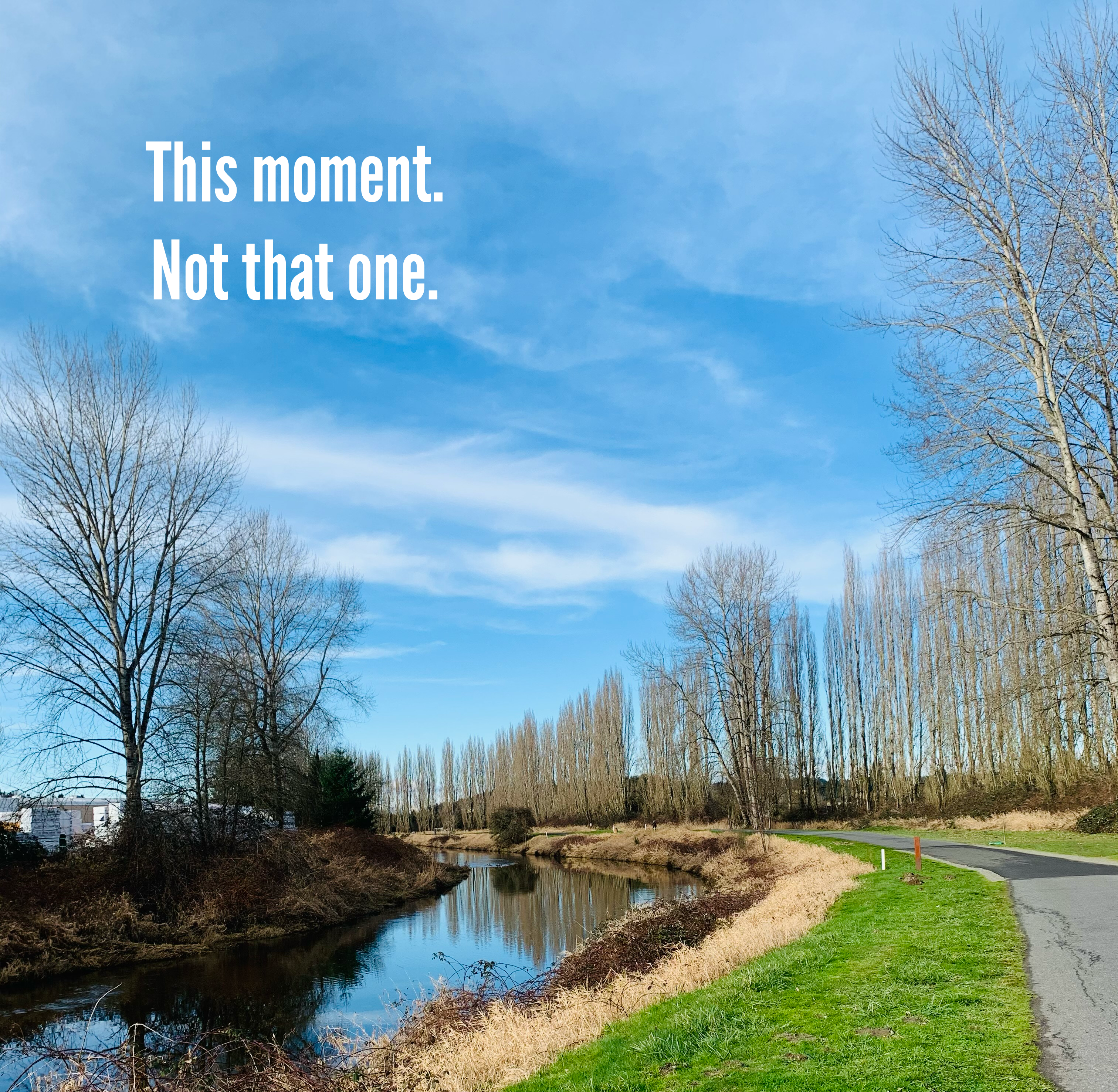
When I’m on my game, I will stop and breathe deeply. I whisper, “This moment, not that one.” It helps when I say “this moment” as I breathe in. Breathing out I whisper “not that one,” and visualize the anxious thought dissipating. The present moment always contains some stillness that I can tap into until my body begins to soften.

The antidote for truly calming anxious thoughts is generally not an action step. After we get our minds to settle a bit, it’s generally the opposite. This moment, I can breathe deeply, I can allow gratitude and kindness to seep in, I can pray. The most we can do often looks like nothing.

So we get still and breathe deeply. Whatever is causing our anxiety will likely still be there. Our goal isn’t to dissolve the cause, it’s to quiet our nervous system. It’s a practice we learn, and if there’s a lot going on, we learn it over and over all day long.

“THIS moment, not that one.”

Conversations with Friends

I used to observe that when older people got together, it seemed all they talked about were health problems. I remember thinking how sad that was. Can’t they talk about something else, I thought. Change the subject.

But what I didn’t understand then was that all groups of friends talk abut what they are going through at that moment. There’s dating, career challenges, finances. Pregnancy, morning sickness, doctor appointments. Parenting, relational issues, toddlers. It happens in every age group.

Younger people may be uncomfortable listening to older adults talk about health issues. It can feel depressing. But when older people get together, it really helps to talk about all the things. The challenges of getting older are many. And we can’t really understand something until we walk through it. 

Our new “normals” have changed a lot. I am no longer working, my husband is about to retire, I have five doctor appointments this month. Yes five. I feel like my father.

But what makes it all seem more “normal” is that my friends are going through similar things. We share thoughts on what we do all day, how to find purpose in these years, the health challenges we face, things our older kids are going through, where we should go for coffee. And happy hour. You know, all the things.

No one need worry about us having these discussions. Most often, once we’re done being with our likeminded friends, we shift our focus to what others are going through. We probably have a little understanding of what they’re going through because at this age we likely have been there too.

So when we overhear a group of likeminded friends discussing things we find uncomfortable or obsessive, let’s remember that they are processing a stage of life that they’re trying to understand.

The subject doesn’t need to change. A good discussion with friends that understand is better than therapy. Well, actually, it IS therapy. 

The Mind of Morning

“…Put on the mind of morning 
Feel the rush of light spread slowly inside 
The color and stillness of a found world.”
John O’Donohue

At this moment, I’m staying  in a beautiful condo in Palm Springs, giving my body a break from the damp cold Pacific Northwest. Upon waking every morning, there is a button I press to make the blinds go up. Depending on what time I wake up, it can still be dark outside.

But I am not fearful I will find darkness when I open the blinds. Because I know. I know it’s just before the dawn and the light will soon come.

Perhaps I can learn to put on the “mind of morning” through this. I can learn not to decide based on what I see, but what I know. Some days it’s a hard shift. There can be a low level anxiety based on simply seeing. Because often, things look dark.

But I can come to know that seeing darkness does not define the moments ahead. I can trust that deep inside there is a light that can slowly spread. That’s a hard ask at times. We can’t connect to what routinely happens over and over, day after day. The dark is not the final word. 

I may not be able to do that every time. But maybe even just once, I can convert the container of dark thoughts into the mind of morning. I don’t know. Everything is easier when I think about it. Not so easy when it shows up.

But how easy it is to push the button and lift the blinds. Maybe I can bring this “mind of morning” with me into my day. How beautiful to let in whatever is out there. The prelude to morning or the bright light of dawn.

As I lift those blinds, the mind of morning eagerly awaits what’s out there. I guess what I let in each time is hope. A new dawn. A new day.