On Vulnerability

On the surface, vulnerability seems paradoxical. As we get brave enough to share our innermost thoughts and emotions, we often expose the weakness we have tried to hide.  

When we’re younger, we usually protect ourselves with some kind of “armor.” As we’re building relationships, careers, and personalities, we are careful about what we allow others to see. We’re building our lives and protecting our foundations.

But as we get older, we find armor gets heavy. So we begin leaning into vulnerability, which exposes those parts of ourselves that we have protected. Vulnerability takes our weakness, infuses it with courage, and ultimately reveals strength. It’s not always easy to do.

Whether it’s in conversation or on social media, sometimes our picture needs to show the rain, not just the rainbow. No one wants to see the rain day after day, but only showing rainbows is pretentious. The fullness of beauty is about the many facets of life bumping up against each other continually. The good, the bad, and the ugly all at the same time. 

Vulnerability lets people know they are not alone, particularly in their bad and ugly. We can all fall victim to comparison, and when others are continually showing the good, we often fall short. We know our lives contain so much more. And by more, we generally mean less. Less rainbow, less sunshine, less charm. What is wrong with my life?

But when someone offers a glimpse into their struggle, we find a sigh. I am not alone. I’m not the only one with a bit of a mess in a world filled with perfect images. I think we’ve all experienced times when we learned we were not the only ones experiencing a particular situation or fear or sadness. And how we came away just little lighter.

The rain and the rainbow both exist in our lives. Wisdom dictates which one gets highlighted at a particular time. Only as we’re sensitive to the needs of others can we make that call. We are most alive when we take this simple act of vulnerability, wrapped in an unseen layer of courage and strength, and help others feel seen and not alone.

Maybe vulnerability is another word for love.

On Friendship

Being a good friend is about reassurance; it’s about letting our friends know that we believe in them, we trust them, we like them.

An important part of friendship is listening, but here’s the key: To truly listen, we must learn not to compete with their narrative.

When someone shares a challenge, or sadness, or loss with us, they are opening a window into their soul, at that moment. Part of our growth as a good friend is allowing others to take all the air. It’s not always a ping pong match, volleying stories over the net. When someone is sharing something hard with us, we need to resist the temptation to pop the ball back over.

If we hear it like they need us to fix them, we undervalue their strength. It is a slice of their heart, not the entirety. If they don’t ask us to help, we should not offer words. In offering our ears, we endorse their strength.

As we get older, we’re likely to have had an experience that is similar to what they are describing. We can be tempted to jump in and share, giving them the advice or adage that helps them feel better. We all do that from time to time.

But real listening quietly communicates that we believe in them. They are stronger than they know. As our shoulder presses up against their shoulder, our bond with them strengthens. I so value my friends who know when I am going through something and ask, How are you, really? It’s a question we can all learn to sincerely ask.

By resisting the urge to fix our friends, turning their vulnerability into a counseling session, we endorse their strength. After they have a chance to share all that’s in their heart, we have a chance to let them know they are both heard and seen. And that we believe in them.

And isn’t that what we all want? To be seen, to believe we are strong, and to know we are not alone.

Conversations with Friends

I used to observe that when older people got together, it seemed all they talked about were health problems. I remember thinking how sad that was. Can’t they talk about something else, I thought. Change the subject.

But what I didn’t understand then was that all groups of friends talk abut what they are going through at that moment. There’s dating, career challenges, finances. Pregnancy, morning sickness, doctor appointments. Parenting, relational issues, toddlers. It happens in every age group.

Younger people may be uncomfortable listening to older adults talk about health issues. It can feel depressing. But when older people get together, it really helps to talk about all the things. The challenges of getting older are many. And we can’t really understand something until we walk through it. 

Our new “normals” have changed a lot. I am no longer working, my husband is about to retire, I have five doctor appointments this month. Yes five. I feel like my father.

But what makes it all seem more “normal” is that my friends are going through similar things. We share thoughts on what we do all day, how to find purpose in these years, the health challenges we face, things our older kids are going through, where we should go for coffee. And happy hour. You know, all the things.

No one need worry about us having these discussions. Most often, once we’re done being with our likeminded friends, we shift our focus to what others are going through. We probably have a little understanding of what they’re going through because at this age we likely have been there too.

So when we overhear a group of likeminded friends discussing things we find uncomfortable or obsessive, let’s remember that they are processing a stage of life that they’re trying to understand.

The subject doesn’t need to change. A good discussion with friends that understand is better than therapy. Well, actually, it IS therapy. 

The Final Bloom: Or Is It?

So I bought my Christmas amaryllis early November. You heard the story. It didn’t bloom by that holiday, but it had a message for me. Bloom whenever the hell you want. No timetables, baby.

I had written that there is usually activity beneath the surface, but the eye just isn’t picking up on it. Suddenly the thing blooms and we are taken by surprise. It eventually dies back and we are grateful for the beautiful flower it brought forth.

But then, when we expect nothing at all, it blooms again. Well, I didn’t think you had another bloom in you, little guy. And there you go, showing us all that blooms happen even when we think there’s nothing left. This is the third time I’ve been surprised by him.

How many life lessons did that little bulb teach me? 

  1. We need to be patient and trust the process. Time is not our enemy.
  2. Just because the eye doesn’t pick up on activity doesn’t mean that none is taking place.
  3. There is a time for every purpose under heavens but usually we don’t get to choose that time;  that time chooses us.
  4. Maybe the one bloom isn’t the end of the story. Maybe it’s a series of blooms that pop over time when they’re ready. Just because we bloomed once doesn’t mean we’re done.

What we need is the hope that everything resting inside of us will pop when the time is right. We were designed in love to hold so much beauty deep within. I thought that little flower was done, but then I noticed  a little green sprout at the base. I kept it in the light to see if it had anything left. Once again, the amaryllis bloomed.  

I feel a connection with this little flower. We talk and laugh and tell each other we are awesome. I got a lot of bloom left in me. Maybe we’ll both be a little beautiful, loud, and out of place. A perfect, if not at all predictable, time for every purpose under heaven.

Standing at the Starting Line

I recently started a part time job as a sales associate at a local home and garden store. Even though I had a lot of experience in other areas, I would be a “beginner” there. No training on a cash register, no idea where everything is, the one who would have more questions than answers.

Honestly, I feel like I’m starting over in just about every area of my life. That starting line isn’t the same as it was in the past, however. When we are older, we get to bring the confidence that comes from knowing all we have come through.

Sometimes we can look at how different everything looks and feel a little overwhelmed by it all. But it helps to remember that we are reinventing ourselves and these challenging transitions allow for some wonder to slip into our lives. This quiet confidence provides a beauty and a strength which is easily passed on to others. And that is its own reward.

So I’m bringing a smile and a warm hello to all who enter the store. I might have to ask for help at every turn, but I’m not frustrated by that. I am getting to learn new things and meet new people.

I can look backwards and forward from this point because even though I’m starting over, my “success” this time is measured by my confidence. No longer by acceptance or external validation.

True confidence does not come from knowing everyone will like you, or give you the job, or invite you to the event, or give you the award. It is knowing that even if none of those things happen, you will be ok.

For me, this isn’t just about a new job. It’s about new eyes, a new heart, new enthusiasm, and a new hope.

Every morning, the sun says, “It’s time to begin anew.” Every single time, it brings beauty along with it. I see you, my friend. I’m feeling the same way. Let’s go start anew and watch the beauty unfold as we go..

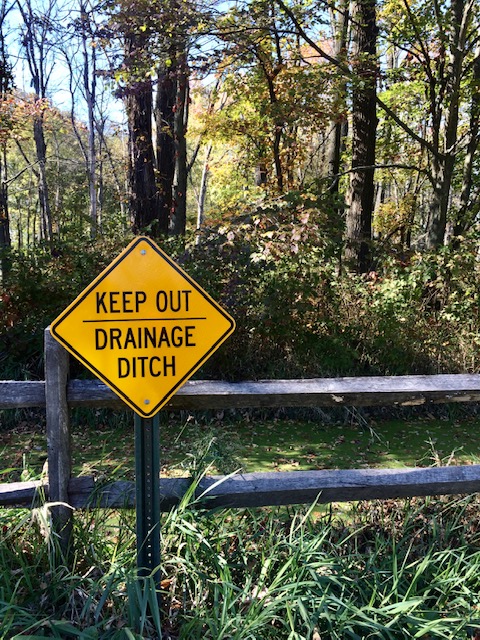
Drainage Ditches

Every day, we navigate between things that drain us and things that replenish us. Our health–both spiritual and physical–is contingent upon how much time we spend in each of those areas.

The big drainers are obvious: stress, sickness, sleepless nights, finances. We are usually aware when we are dealing with the big things. But, it’s those “daily concerns” that can get us. If we aren’t careful of how we manage those, we wind up drained, weary, and discouraged. If only those things came with a warning sign.

Well, actually, maybe they do. If we can get quiet, and focus on the present moment, our conscience will likely be warning us. Keep out of this ditch, it will whisper. We may be involved with talking negatively, thinking judgmentally, meditating on tomorrow’s problems, contemplating the “what ifs” of today, embracing the lies that parade as truth, self-focus, unforgiveness, excessive social media.

The bad and ugly come to drain us every day. But there are ways to stay out of drainage ditches. Mindfulness is one of the best ways to do this because it can open us up to our thoughts. 

I am learning to be still inside that I might observe my thoughts and, without judgment, gently replace them. I wish I could say I do this quickly every single time, but I am practicing and getting a little better at it.

We get more of what we focus on, so we want our thoughts focused on things that are good and beautiful and authentic. Those kinds of thoughts aren’t our go-to’s. Although we usually can’t control our circumstances, we can always choose our response.

It is in stillness that we will hear the words, “Keep Out. Drainage Ditch.” Kinda like a sign.

Prismatic Perspectives

One of my greatest joys as a teacher was teaching a Logic course to 8th graders. That age group just loves to argue. They are quick to find fallacies and invalid conclusions, especially when they are someone else’s!

If I were teaching today, I would introduce a new fallacy called the “I don’t understand how” fallacy. The more you are aware of it, the more you hear it.
 
I was listening to an interview with a public figure who was talking about one of the presidential candidates. “I don’t understand how anyone could have voted for someone who…(a number of reasons). I have friends who voted for him and I don’t understand how that’s possible.”

It’s as if our lack of understanding is proof that someone is wrong. If something is beyond our ability to believe, then anyone who believes that is wrong. 

Most fallacies oversimplify another’s point of view by assigning it the worst possible motive. Instead of saying “I don’t understand how” and leaving it there, maybe we should be saying “I want to understand how.” The public figure who couldn’t understand how his friends voted for a candidate could have asked. I have kind, thoughtful, and compassionate friends who voted both parties.

Their reasons are as complex as they are. They are standing in different places, and they see different “colors.” We have prismatic perspectives. The light we see is reflected differently and our perspectives will be different as well. 

I really don’t care about opinions on facebook and twitter. But if people I care about have different perspectives, I want to be able to understand them. I don’t want to ever assume the worst possible motive. It’s really ridiculous to argue a conclusion. It is important to understand how people reach conclusions, and often, it takes time to peel back emotions and get to reasons.

It would be nice to actually argue the issues involved, which would involve supported premises and conclusions that follow. But until then, maybe we could at least remember that even if we can only see one color of the prism, there are at least six others that may just as “true.” 

Maybe it’s easier just to say, “I don’t understand how…”

Narrative of Strength

Yesterday, I was out walking, struggling with so many things. Why is it that when we struggle, we often rehearse our weaknesses?

A small voice inside whispered: Instead of another narrative of weakness, can we craft one of strength? Ha. I feel nothing like that right now. “Rehearse the strength you’ve seen in your life,” it whispered.

***It can take a minute to shift a story. ***

I remembered back to when I moved here. Just me and my Pontiac Sunbird with everything I owned. I had gotten accepted into the doctoral program at the University of Washington as a Graduate Teaching Assistant. So off I went.

I knew no one and nothing about this city that my mom claimed was the farthest point I could possibly go excepting Alaska and Hawaii. I moved into an apartment that I later learned was owned by a slumlord. When the people upstairs took a shower, it dripped into my living room. I had bug bites over my entire body. I found someone looking for a roommate and moved out, losing rent and deposit. Not a great start. 

I had this perfect NJ accent, having lived only 20 miles outside New York City my whole life. When I walked into the Public Speaking class that I would be teaching, I was met by half the football team, each one deciding my accent was fair game. I was intimidated. I worked hard to get rid of that accent so I could be taken seriously. Eventually, they had to get up and give speeches, and the power was mine. Never underestimate a 100 pound gal from New Jersey.

I eventually began to feel more at home here. I bought a house, opened a mortgage company and became a real estate agent at a great company in the Greenlake area. 

Always competitive, I ran a 10K with some of my fellow realtors. Who would get the fastest time? Again, never underestimate. I ran that thing in 38 minutes. I registered for a marathon and ran it in 3:38. I wanted to become an aerobics instructor, and I did that too. Classes of up to 60 students, a couple times a day. The guy who hired me became my husband. 

After marriage, I birthed five children and suffered three pretty rough miscarriages. All in eight years. Our second child had special needs, and one very dark night, when he was 6 months old, the doctor told us he would “never be any good.” Exact words. We hunted down anyone who had a more positive perspective, and although there were still some extremely difficult days, he made much progress. He definitely has special needs, but he walks and talks and jokes and brings us much joy. 

Over the next years, I became involved in the school my kids would attend. I taught classes, acted as vice principal, and poured my life into building relationships with fellow teachers and students. Oh, and possibly one of my greatest feats: getting myself and five children out the door by 7:15, ready for the day at school. Lunches (most often) in hand.
 
I am a social introvert, loving people but absolutely needing  time alone. Yeah, that pretty much never happened. Some days, when I got to take a shower, it was hard convincing myself to turn the water off. Just one more hour…

Then there is the repetitiveness that comes with raising children. Answering their why’s, reminding them to brush their teeth, pick up their toys, be nice to their siblings. All while trying to shape them into kind and compassionate humans.

I am still married. Anyone who has been married past the honeymoon knows what a feat that is. Choosing day after day to let love win–a combination of resilience, humor, and commitment that can only come by flexing those muscles one day at a time, over and over again. Some days I was pretty sore.

Ok, those are a couple things I came up with. It’s long, but maybe someone needs to read it. When others share their stories, I can more easily find my own. Many will have narratives showing far greater strength.

It’s obvious by watching the news that there is more than one way to spin a story. We have to take control of the way our story is being told. If we can’t do it on our own, maybe we get together with someone who loves us and knows us well. 

I recently sat with a friend and showed her a tattoo that my daughter had given me. It is a small lightening bolt on my ankle. She commented that it was a reminder that I am a superhero.  Well, that’s not exactly what I thought when I was getting it. But, thank you friend, for seeing something I didn’t. It helps my story.

We’ve lived a lot of days; let’s find the good, the true, and the wonderful parts of them. And since we are the ones telling the story, let’s create a narrative of strength. Let’s write a story where we are a superhero, no matter how many twists and turns that story has to take. 

***Would we want to read a story told any other way?***

Chase the Joy

Graduatiton

Sunday we had the privilege of watching our son Evan graduate from the University of Washington. We were there mostly for those five seconds his name would be called and he would walk across the stage. For the other 3+ hours, we hoped for something that would make it a little easier to sit there.

We got it in the form of a commencement address by noted author, poet, and screenwriter Sherman Alexie, a Spokane/Coeur d’Alene Indian. Someone should add comedian to that triad of adjectives. He brought a perfect mix of serious and funny to that hot crowded gym.

He began by noting the paradox of celebrating and being joyful in light of the mass murder of 49 young men in Orlando the day before. It really is the great paradox of life. Tragedy and joy occur simultaneously, parallel to each other in our world. Do we focus on grief or focus on joy? Many us feel like we are betraying one when choosing the other. He said it felt wrong to choose joy in the face of such tragedy.

The answer to the dilemma came from his 14-year old son. “Isn’t this a college graduation?” he asked. “Then you must choose joy, Dad. You must choose joy today.” There truly is a time for every purpose under heaven.

The lens we look through must be big enough to include both. We have to be able to mourn with those who mourn and rejoice with those who rejoice. Our time spent in grief must, at some point, match our time spent in joy or we get unbalanced. Lack of balance throws us off and makes us walk with a limp.

Sherman told a story of needing to go through brain surgery to remove a benign tumor. When he finally woke up after surgery, he saw everyone standing around him, including the head of surgery, an eastern Indian doctor. His first thought was to tell his doctor an “inappropriate joke.”

“I bet it’s the first time an Indian ever scalped an Indian.” No one even cracked a smile. He thought maybe something was seriously wrong with him. His wife came over to him and gently leaned down. He panicked over what she was going to tell him. “Sherman, you’ve told that joke 11 times,” she said. Ah, he thought, the power of a good anesthetic drug!

He said the point is that everyone needs a good editor. Go ahead and tell an inappropriate joke if that keeps your sense of humor alive. But only tell it once. Keep someone in your corner who will edit you if need be. Make sure your sense of humor equals your sense of grief. Grieve when you must, but chase the joy that’s all around you the other times. Chase the joy. Whenever possible, chase the joy.

I got some valuable instruction at a college graduation yesterday. And some much needed laughter for my saddened soul.

Passion: Dream It or Live It

waterfalls

“Do what you love and you won’t work a day in your life.”

This quote gets thrown around like a guiding principle for life. Find your passion. Do what you love. Don’t settle. Don’t work.

For many, passion has become the number one deciding factor in pursuing careers. And it can be confusing, misleading, and wrong for so many people.

During times of career challenges, I have listened to people ask my husband: What are you passionate about? He couldn’t think of one thing, at least relative to work. He had been in sales and, as anyone who knew my husband could attest, sales was definitely not his passion. But he couldn’t think of a passion which would lead him to a new job. That question often led to discouragement.

I think a better principle might be: “Be passionate about your life and you will find a million ways to be passionate about your job.” Then, even though you may have a job that isn’t your passion, you see a bigger picture. Maybe seemingly “lesser values” need to come forward again. Maybe values like respect, faithfulness, excellence, and kindness are not fully developed and need to come forth.

Being passionate about life can influence so many others. It is how we think about our everyday, ordinary lives. No matter what our circumstances—which, by the way, are always in flux.

Knowing our value apart from what we do is paramount. If we wait to find our passion or decide that life only counts when we are living our dream, we miss a lot of life. It’s not about resigning to life as it is, but rather having a confidence that I am where I am for a reason. It isn’t a lazy “settling,” but a purposeful trusting. We need to recognize that the everyday things of today are training us for tomorrow. Which may or may not translate to “having the job we love.”

My husband eventually got another sales job. It was not his “dream job,” but he has given it everything he has, has treated people with respect, and has valued his customers with the highest level of customer service. The man without a passion for sales just got named one of the top sales reps in the country. And rewarded with an amazing trip to sunny tropical places!

Follow dreams, passions, and adventure whenever that is the right course. But always remember that our lives are intrinsically valuable apart from what we do. If we are passionate about our lives, every day affords the opportunity to practice excellence, respect, and kindness. We can make our everyday ordinary lives look like they matter a whole lot. Because really, they do.

“How we do anything is how we do everything.”